Abstract
China's urbanization has transitioned into a phase characterized by stock revitalization and quality enhancement, wherein the concept of "urban regeneration and ecological restoration" (dual rehabilitation) serves as a pivotal strategy for mitigating accumulated urban challenges. As this paradigm evolves, conventional "demolition-led" renewal models prove increasingly inadequate for historic districts, failing to accommodate their intrinsic spatial heterogeneity and cultural continuity requirements. Consequently, the exploration of innovative revitalization approaches has become an urgent imperative. Such districts universally confront multifaceted issues including severe shortages of public spaces, fragmented cultural legacies, and significantly diminished socioeconomic vitality. To address these systemic deficiencies, this study proposes enhancing the resilience of historic districts through three critical dimensions: spatial restructuring, functional reprogramming, and temporal adaptability. By innovatively integrating "modular intervention" methodology with "resilient urban renewal" frameworks, the research establishes an adaptive, low-intervention, and self-sustaining revitalization pathway. This approach specifically synthesizes resilient urban development theory with modular landscape facility design principles, aligning with dual-repair objectives. Empirical validation via the Erdao Street case study in Yan'an demonstrates the superior contextual adaptability of modular systems - which employ prefabricated, reconfigurable units to minimize site disturbance while activating underutilized spaces. The resultant revitalization model demonstrated enhanced community engagement and measurable vitality recovery during implementation. This integrated framework advances a replicable theoretical-practical paradigm for reconciling heritage conservation with contemporary urban resilience demands.
Keywords
Historic District, Resilient Renewal, Modular Landscape, Urban Repair, Micro-insertion
1. Resilience-Oriented Renewal Needs and Challenges in Historic Districts
1.1. Transition from Demolition-Led Renewal to Resilience and Incremental Regeneration
Historic districts are part of the cultural heritage of a city, and protecting historic architectural landscapes can lead to sustainable urban features
| [1] | Larkham, P., & Adams, D. (2019). Persistence, inertia, adaptation and life cycle: applying urban morphological ideas to conceptualise sustainable city-centre change. ICONARP International Journal of Architecture and Planning, 7, 73-94. |
[1]
. As urban development progresses into the stock renewal phase, historic districts universally confront practical challenges including chaotic urban fabric, fragmented spatial configurations, traffic congestion, and inadequate public facilities. The conventional "demolition-led" approach—characterized by large-scale clearance and reconstruction—may deliver rapid visual transformations in the short term. However, it incurs irreversible consequences: the destruction of traditional streetscapes and architecture, displacement of original residents, and subversion of spatial morphology and community structures
| [2] | Dong Y N, Han D Q & Huang J. (2021). The process and participation of urban design from the perspective of small-scale and progressive conservation and regeneration of the Xiaoxi Lake historic area in Nanjing. shidaijianzhu, (01), 51-55. [in Chinese] https://doi.org/10.13717/j.cnki.ta.2021.01.010 |
[2]
. Urban renewal projects may, for instance, lead to increased property values and more attractive living conditions, but they may also lead to gentrification processes through the displacement of existing residents and/or the loss of historical and cultural heritage
| [3] | Marcus, L., & Colding, J. (2023). Placing urban renewal in the context of the resilience adaptive cycle. Land, 13(1), 8. |
[3]
. Such practices not only sever historical-cultural continuities but also trigger gentrification, a process that forcibly displaces indigenous communities and erodes neighborhood authenticity. For historic districts requiring preservation of cultural identity and spatial heritage, this "scrap-and-rebuild" model proves fundamentally unsustainable. Consequently, urban renewal philosophy and practice are evolving toward resilience-focused and incremental regeneration paradigms. This transition prioritizes preserving district memory while sustaining community vitality through context-sensitive interventions. The imperative now lies in adopting adaptive methodologies that reconcile heritage conservation with contemporary socioeconomic needs through low-impact, phased implementations.
1.2. The Adaptive Significance of Resilience-Oriented Renewal in Historic Districts
The concept of resilience originated in engineering and has since evolved to encompass ecological and social dimensions, reflecting notions of stability, balance, and adaptability
| [4] | Ren, M., & Chai, N. (2025). Resilience Renewal Design Strategy for Aging Communities in Traditional Historical and Cultural Districts: Reflections on the Practice of the Sizhou’an Community in China. Buildings, 15(6), 965. |
[4]
. Resilience design enables built environments to perpetually accommodate evolving demands across extended life cycles
. To prevent historic districts from vacillating between unsustainable extremes—namely rigid frozen conservation and crude demolition-led renewal—the integration of resilience principles with incremental conservation offers an essential solution. It was exactly the continuity of the urban fabric that enacted the self-organizing, continuously changing, adapting formation of neighborhoods in historical cities
| [6] | Mehaffy, M. W., Porta, S., & Romice, O. (2015). The “neighbourhood unit” on trial: A case study in the impacts of urban morphology. Journal of Urbanism, 8(2), 199-217. |
[6]
. Under this paradigm, districts undergo progressive continuous recalibration, actively assimilating socioeconomic shifts, responding to environmental pressures, and integrating emergent technologies and governance models. Such dynamic interventions sustain cultural-spatial continuity while enhancing district vitality, transforming historic fabrics from static museum exhibits into living systems capable of adaptive evolution. Consequently, resilience-oriented renewal fundamentally enables sustained livability through contextually sensitive metamorphosis, balancing heritage integrity with contemporary functionality via modular low-intervention strategies that prioritize organic growth over disruptive transformation.
1.3. Feasibility and Innovative Value of Modular Landscape Intervention
Modular design was initially proposed in some European countries, with its concept formally established in the mid-20th century. Modular design is defined as follows: Based on functional analysis of products within a defined scope that have different functions, or identical functions but varying performance and specifications, a series of functional modules are created and designed. Through the selection and combination of these modules, diverse products can be constituted to satisfy heterogeneous market demands. The main advantages of modular design include design flexibility, augmentation, and cost reduction
| [7] | Tseng, M. M., Wang, Y., & Jiao, R. J. (2018). Modular design. In CIRP encyclopedia of production engineering (pp. 1-10). Springer, Berlin, Heidelberg. |
[7]
. The primary objective is to fulfill human needs while achieving cost efficiency through module recombination. When a major urban function or service is provided by a centralized entity or infrastructure, it is more vulnerable to failure. When the same function is provided by a distributed or decentralized system, it is more resilient to disturbance
| [8] | Ahern, J. (2011). From fail-safe to safe-to-fail: Sustainability and resilience in the new urban world. Landscape and Urban Planning, 100(4), 341-343. |
[8]
. When applying modular strategies to historic district landscape revitalization, their feasibility manifests in the high efficiency, low disturbance, and dynamic adjustability brought by standardized modules. Their innovative value lies in achieving spatial restoration and cultural-spatial continuity through lightweight intervention.
1.4. Research Objectives, Questions, and Paper Structure
This study aims to explore innovative pathways for historic district preservation and revitalization, with dual core foci: Firstly, how to enhance spatial functionality through lightweight intervention without compromising original cultural-spatial continuity; Secondly, whether modular landscape systems can establish a sustainable and transferable renewal framework for historic districts. To address these objectives, the research adopts principles of incremental, continuous resilience-oriented renewal to pursue a balanced development pathway that concurrently safeguards heritage legacies and enhances local human settlements.
2. Theoretical Foundations and Research Review
2.1. Core Framework of Resilient Urban Theory
Resilient urban theory emphasizes enhancing urban adaptability through incremental continuous resilience adjustments across spatial, functional, and temporal dimensions. A resilient urban system should entail "adaptive" cycles that “alternate between long periods of aggregation and transformation of resources and shorter periods that create opportunities for innovation”, thereby ensuring survivability of the system
| [9] | Roggema, R. (2014). Towards enhanced resilience in city design: a proposition. Land, 3(2), 460-481. |
[9]
. This three-dimensional framework comprises: 1) Spatial resilience denoting urban spatial carriers' reconfigurability and reorganizational capacity; 2) Functional resilience addressing population demand adaptability; 3) Temporal resilience establishing dynamic equilibrium between heritage conservation and future development. Collectively, these dimensions forge malleable spaces, adaptive functionality, and sustainable resilient cities and any resilient system must be able to face the uncertainty and relativity of the future conditions
| [10] | Sharifi, A., & Yamagata, Y. (2016). Principles and criteria for assessing urban energy resilience: A literature review. Renewable and Sustainable Energy Reviews, 60, 1654-1677. |
[10]
.
2.2. Theoretical System and Case Studies of Modular Landscape Intervention
As a core technical vehicle for resilient urban objectives, modular landscape endows urban spaces with dynamic adaptability through iterable, reconfigurable, and dismountable unit systems. Its theoretical framework builds upon resilient urban theory:
1) Spatially: Enabling reversible reconfiguration and flexible expansion
2) Functionally: Facilitating adaptable scenario transitions through preset compatibility
3) Temporally: Implementing graded lifecycle mechanisms (temporary/semi-permanent/permanent) within incremental renewal sequences.
Sustainability entails meeting “the needs of the present without compromising the ability of future generations to meet their own needs”
| [11] | Bruntland, G. (1987). Our common future. The world commission on environment 1 and development, 45-65. |
[11]
. This system dynamically generates diversified strategies across varying site conditions and renewal phases, fulfilling heterogeneous urban renewal demands through resilient systems.
2.3. Integrative Logic: Resilient Renewal + Modular Intervention
Resilient renewal provides dynamic adaptation theory for modular systems, guiding practice through incremental adjustments and resilience development principles. Modular technology conversely serves as a technical vehicle for resilient renewal via flexible reconfiguration and reversible modifications. Flexibility means that a system should have the ability to "adapt to changing conditions"
| [12] | Willis, H. H., & Loa, K. (2015). Measuring the resilience of energy distribution systems (p. 38). Santa Monica, CA, USA: Rand Corporation. |
[12]
Their synthesis establishes a unique synergy: guided by resilient renewal's tripartite dimensions, plug-and-play components and phased renewal solutions achieve minimal-intervention adaptation. This balances functional responsiveness with cultural preservation—developing through conservation—to sustain spatial vitality while reconciling heritage values with contemporary functionality.
2.4. Comparative Review of Historic District Renewal Strategies
China's historic district renewal prioritizes heritage conservation and living environment improvement through micro-regeneration approaches. However, it faces challenges including cultural-spatial discontinuity, indigenous population displacement, and excessive commercial development. These issues erode community living environments and threaten cultural continuity.
Globally, three representative strategies exist:
1) Texture repair: Barcelona's El Born district embedding 200+ micro-plazas
2) Functional regeneration: New York's High Line Park transforming railways into cultural landmarks
3) Community empowerment: Singapore's Kreta Ayer maintaining indigenous residency rates through policy incentives.
Both domestic and international contexts face diminished district vitality and gentrification pressures. International strategies emphasize meticulous spatial repair and community vitality stimulation. China should adopt micro-renewal methodologies by: 1) utilizing texture repair techniques for spatial restoration; 2) employing functional regeneration to counterbalance gentrification risks; 3) balancing historic environmental preservation with cultural resilience. This approach explores context-appropriate renewal pathways for sustainable historic district development.
3. Case Study Background: Erdao Street, Yan'an
3.1. Locational Characteristics and Historical-Cultural Heritage Profile
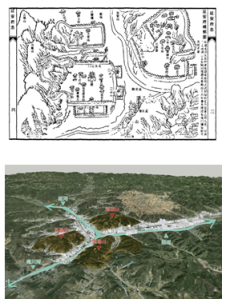
Erdao Street spans 1,100 meters in Yan'an's urban core, intersecting the city's "Three Mountains and Two Rivers" spatial pattern while serving economic, tourism, and cultural functions. As a gateway for city branding and a mandatory route for red tourism circuits, its status as the city's premier commercial-cultural district continues to escalate.
Yan'an's historic walled city exemplifies traditional Chinese mountain-water urbanism. Northern Song statesman Fan Zhongyan critically influenced its spatial formation
Figure 1. Erdao Street occupies the original plain terrain within the walled city. Extant heritage includes: only the Fenghuang Mountain section of the city wall remains; the historical street network persists with three east-west arteries corresponding to modern Erdao Street, Center Lane, and North Avenue; no historical buildings survive except the reconstructed Anlan Tower at the South Gate site.
Figure 1. Mountain-water spatial pattern of historic Yan'an.
3.2. Limitations of Current Renewal Strategy
Cosmetic renovation prioritizes short-term aesthetic restoration through standardized faux-historic facades and homogenized commercial programs. This approach neglects historical authenticity and diverse community needs, incurring systematic deactivation risks:
1) Historically: Fragments historical stratification logic, reducing rich traces to superficial pastiche
2) Socially: Accelerates gentrification that displaces indigenous residents and erodes living cultural transmission mechanisms
Consequently, historic districts become cultural voids within landscapes of uniform replication. Authentic renewal requires architectural reconfiguration to negotiate tradition and modernity through calibrated contemporary interventions-prioritizing responsiveness to present and future needs over nostalgic mimicry
| [13] | Ye Lu, Wang Liang & Wang Chang. (2017). "Micro-updating" of Historical and Cultural Blocks: A Design Study of the Santiaoying Plot in Laomen East, Nanjing. jianzhuxuebao, (04), 82-86. [in Chinese] |
[13]
.
3.3. Objectives and Prerequisites for Resilience-Oriented Renewal
Addressing systematic deactivation risks triggered by cosmetic renovation—spatial deactivation, historical discontinuity, and gentrification—this study proposes renewal strategies centered on resilience principles. The core objective entails establishing a dynamic adaptation mechanism to restore continuity in historical stratification, sustain living heritage transmission of community memory, and accommodate differentiated demands of multi-stakeholder groups including residents, merchants, and tourists through an incremental sustainable recalibration process.
Strategy implementation must adhere to two fundamental prerequisites:
1) Heritage conservation shall strictly follow authenticity and integrity principles to preserve physical relics and safeguard cultural DNA;
2) Livelihood safeguards must ensure basic rights of indigenous residents—including housing, employment development, and social networks—remain intact against erosion. Thus, Erdao Street's renewal practice can transcend short-term superficial limitations toward a sustainable pathway.
4. Elastic Pathway Construction via Modular Landscape Intervention
4.1. Node Identification Mechanism
Erdao Street's renewal practice establishes a "derelict space-heritage anchor-community interface" spatial governance framework through node identification. This enables resilience-oriented modular landscape micro-interventions. The process first identifies derelict spaces from functional decline—such as high-vacancy shantytowns and obsolete alleyways—then systematically screens heritage anchors carrying cultural DNA. These include historically significant structures like Wenchang Pavilion, Bell-and-Drum Tower ruins, and wall fragments. Community interfaces dynamically balance heritage conservation with neighborhood development through social resilience mechanisms.
4.2. Composition of Modular Landscape System
Modular design facilitates functional evolution of products. It enables the generation of new functions to satisfy diversified demands by freely updating specific modules while maintaining universal modules, adapting to temporal and spatial changes
. Modular landscape systems require coordinated synergy of three attributes: eco-restoration, cultural display, and community interaction. These evolve collaboratively: rain gardens and understory green spaces constitute eco-restoration modules; digital media engaging revolutionary memory forms cultural display modules; movable structures combined with small plazas build flexible social modules.
Erdao Street spans 1,100 meters with varying building heights, architectural styles, and facade deterioration levels. Segment-specific design strategies are adopted according to actual conditions. When embedding modular landscape facilities in each segment, the unique characteristics of that segment are fully considered. Yan' an cultural elements are distilled, transforming modular landscapes into mediators between historical memory and contemporary life, ultimately creating districts embodying Yan'an' s distinctive identity.
4.2.1. Segment A: Current Status and Design Strategy
1) Current Status
Segment A intersects with Daqiao Street junction. Despite an underground pedestrian passage, aging and damaged roadside railings prompt pedestrians to jaywalk across the roadway, creating safety hazards. Its facade condition is shown in
Figure 2.
Figure 2. Current situation of Section A.Current situation of Section A.
2) Design Strategy
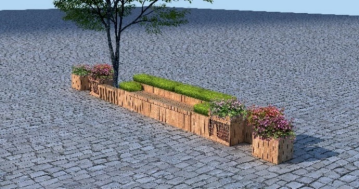
Segment A' s street width (>6 meters) accommodates multifunctional landscape facilities. Modular mobile planter systems introduce greenery while enabling layout adjustments to accommodate sudden street narrowing. These planters integrate seating through corten steel and perforated wood combinations. Side panels feature Yan' an' s iconic Pagoda Hill motif, delivering three functions: Eco-restoration (vegetation), Cultural display (Pagoda Hill motif), Community interaction (mobile seating)
Figure 3.
Figure 3. Modular Landscape Facility Assembly for Yan' an Erdao Street Section A (Mobile Planter Systems + Mobile Seating Units + Tree Pit Enclosures).Modular Landscape Facility Assembly for Yan' an Erdao Street Section A (Mobile Planter Systems + Mobile Seating Units + Tree Pit Enclosures).
4.2.2. Segment B: Current Status and Design Strategy
1) Current Status
Segment B lies within a commercial cluster with parking lots, malls, and intersecting alleys. Chaotic traffic flow creates pedestrian-vehicle conflicts, compounded by unclear signage and disorderly billboards.
Figure 4 Figure 4. Current situation of Section B.Current situation of Section B.
2) Design Strategy
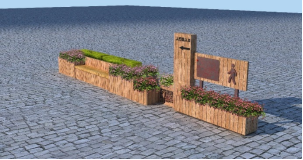
Rigid guardrails are replaced with mobile planter arrays integrating seating, forming a modular flexible interface that achieves three core functions: Eco-restoration through combinable plant units creating soft barriers while enriching street vegetation; Community interaction by establishing physical separation that preserves visual permeability to mitigate traffic conflicts; and Cultural display via silhouettes of revolutionary dancer figures migrating to Yan' an that convey the region' s cultural ethos.
Figure 54.2.2. Segment C: Current Status and Design Strategy
1) Current Status
Segment C borders Yan' an University Affiliated Hospital west and aging residences north. Narrow streets exhibit chaotic traffic, insufficient greenery, and inadequate waste receptacles.
Figure 6 Figure 6. Current situation of Section B.Current situation of Section B.
2) Design Strategy
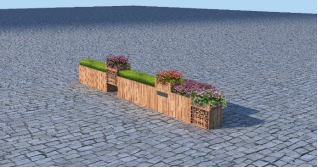
Spatial constraints necessitate compact modules of mobile planting beds with tree pits, achieving integrated functions through vertical layering that expands greenery without impeding pedestrian flow for eco-restoration, by incorporating waste disposal features to enhance urban furniture utility for community interaction, and via Loess Plateau cave dwelling motifs adorning planter facades for cultural display—culminating in functional-aesthetic synthesis while maintaining transit efficiency.
Figure 74.3. Modular Deployment Pathway Strategy
Modular landscape deployment achieves resilient adaptation through tri-scale strategies. At the micro-scale, punctate resilience integrates modular mobile planters with seating and cultural display functions within high-density zones. At the medium scale, linear permeability replaces rigid guardrails with mobile planter arrays to form connective links. At the macro scale, areal aggregation clusters modular mobile structures within plazas to activate social vibrancy. This culminates in three deployment modes: punctate resilience, linear permeability, and areal aggregation.
4.4. Temporal Resilience of Modular Systems: Iterability, Reconfigurability, and Dismountability
Modular systems achieve incremental resilience-oriented renewal through their intrinsic capacities for iteration, reconfiguration, and disassembly, characterized by swift installation and replacement. The temporal resilience of modular landscapes implements a three-tiered lifecycle classification—temporary, semi-permanent, and permanent—enabling continuous adaptation mechanisms through chronological combinations and transformations. At the micro-temporal scale, daily module reconfigurations accommodate shifting functional demands across time segments; at the macro-temporal scale, iteratively replaceable components sustain elastic adaptation to emerging needs, constructing a resilience continuum from instantaneous responsiveness to long-term development.
4.5. Module Management Mechanism and Adaptive Maintenance Strategy
Modular landscape operation leverages dismountable units to establish a management mechanism covering planning, deployment, monitoring, and renewal cycles. It defines tripartite resilient responsibilities: governments establish renewal standards; communities lead daily maintenance; third parties implement technical operation. Digital tools dynamically support module reconfiguration decisions, exemplified by GIS mapping for unit displacement tracking and QR-coded lifecycle tracing.
Adaptive maintenance strategies integrate resilience-oriented logic, conducting dynamic assessments across three dimensions: spatial efficiency utilization, cultural continuity integrity, and resident satisfaction metrics. Community participation in module adjustment protocols and operational training is empowered, forming self-adaptive conservation networks that evolve with iterative module updates.
5. Renewal Outcomes and Resilience Value Assessment
5.1. Analysis of Post-Renewal Spatial Vitality and Behavioral Shifts
Landscape vitality hinges not solely on physical transformations but fundamentally on the sustained generation of diversified human-space interactions. Through the integrated application of the modular + resilience-oriented renewal pathway, Erdao Street in Yan' an demonstrates significant post-intervention shifts in usage patterns alongside activated behavioral ecosystem effects, substantiating the capacity of modular interventions to recalibrate human-environment dynamics within historic urban fabrics.
1) Behavioral Spatial Restructuring and Extended Dwelling Duration Analysis
Pre-renewal spatial patterns across Sections A/B/C of Erdao Street exhibited traffic-dominated-functional-deficiency characteristics within linear corridors, lacking lingering nodes, seating facilities, or cultural interfaces. User behavior adhered to compressed models of rapid transit, low residency, and weak engagement. Post-renewal implantation of diverse mobile landscape modules generated micro-spaces facilitating dwelling-observing-interacting activities, transforming unidirectional circulation systems into integrated punctate-linear-areal behavioral matrices.
Field observation records confirmed substantial residency duration increases: Section A extended from 4.5 to 12.3 minutes; Section B elevated from 5.2 to 13.1 minutes; Section C rose from 3.8 to 9.5 minutes despite spatial limitations. Modular seating, shading systems, and cultural identifiers collectively stimulated composite dwelling-observing-interacting behaviors, converting circulation-dominated corridors into experiential-participatory spaces through integrated spatial-behavioral reprogramming.
2) Spatial Thermal Remapping and Intensity Elevatio
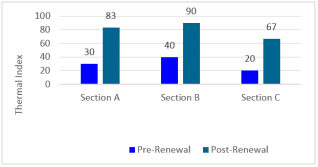
Infrared thermal sensing combined with diurnal behavioral logs generated thermal mapping revealing spatial heat signatures transitioned from linear circulation to nodal aggregation post-renewal. Section A's planter-integrated seating zones became high-frequency dwelling points; spontaneous phototaking and social clustering emerged around Section B's migratory dancer silhouette wall; Section C's integrated planter beds with waste receptacles formed brief dwelling and dispersion nodes within narrow segments.
Comparative analysis of pre/post-renewal daily flows and crowd density distributions confirmed overall daily residency increased from below 80 to over 240 persons, with intensification of thermal cores during peak intervals. During festivals and market events, Section B's thermal indices surged by 230%, demonstrating modular facilities' potent spatial priming capacity and amplification effects for behavioral aggregation and sense-of-place generation, such as
Figure 8.
Figure 8. Comparative Thermal Index Variation in District Sections.
3) Diversified Behavioral Engagement and Enhanced Participation Frequency
Pre-renewal district activities exhibited singular patterns dominated by transit and commercial flows; post-renewal behavioral ecology expanded significantly to encompass composite functions including resting, phototaking, socializing, children' s play, reading, and incidental performances, manifesting spatial elastic spillover effects. Surveys and interviews indicated approximately 73% of residents and merchants perceived enhanced lived vibrancy within the district, while 56% of visitors expressed willingness to prolong stays or revisit, collectively confirming substantial elevation in usage stickiness and place attachment metrics.
The transformed behavioral ecosystem shifted from predominantly transit-commercial movements to multifunctional engagements encompassing resting, photography, socialization, children' s recreation, reading, and spontaneous cultural activities—fully demonstrating elastic spillover dynamics in spatial functionality. Empirical data revealed 73% of local stakeholders reported intensified quotidian vitality and 56% of tourists committed to extended visits or returns, evidencing measurable advancement in spatial magnetism and usage tenacity.
5.2. Shifts in Resident and Visitor Place Attachment
The ultimate objective of spatial renewal extends beyond formal improvements to fundamentally reconstruct emotional connections and cultural identification between people and places. In many neighborhoods, everyone knows everyone, and many feel “at home” in the neighborhood spaces
| [15] | Keiner-Presov, N. Strategies for the Renewal of Urban Housing: Evaluation from the Perspective of Social Fairness. Ph.D. Dissertation, Technion—Israel Institute of Technology, Haufa, Israel, 2017. (In Hebrew). |
[15]
. Through its low-intervention, incremental modular resilience-oriented renewal pathway, Yan' an Erdao Street has catalyzed perceptual repositioning and value rediscovery of the district among diverse user groups. This transformation manifests highly consistent social acceptance and multi-tiered positive feedback across stakeholder cohorts, demonstrating the capacity of context-sensitive interventions to regenerate socio-spatial bonds within historic urban fabrics.
Resident responses demonstrate dual affirmation of cultural continuity and daily adaptability: 78% of indigenous residents perceived enhanced livability post-renewal; 72% acknowledged authentic spatial expression of Yan'an's local culture; 80% expressed willingness to sustainably utilize and participate in module maintenance. This validates modular intervention's efficacy in preserving quotidian scene coherence while elevating public environmental quality without indigenous displacement—establishing a "minimal disturbance-maximal acceptance" community adoption mechanism.
Merchant outcomes reveal synergistic advancement in spatial integration and operational resilience: approximately 65% of street-front businesses reported significant environmental order improvements with prolonged customer residency; 70% demonstrated proactive engagement in co-building or operational activities. Modular strategies function not merely as spatial restructuring instruments but as catalytic agents stimulating micro-economic circulation—actualizing a tripartite symbiotic network integrating spatial renewal, commercial vitality optimization, and community participation.
Visitor feedback indicates multidimensional narrative-cognition linkage: 82% recognized heightened memorability and communicability; 68% affirmed increased authenticity and place-specific qualities in cultural symbolism expression; 76% endorsed recommending it as a neo-revolutionary cultural experience zone. Serving as cultural narrative vectors, modular landscapes restructured visitor cognitive logic through tangible symbolic representation—forging a weak-intervention-strong-experience pathway from sensory triggers to cultural resonance.
Table 1. Analysis of Shifts in Resident and Visitor Place Attachment.
Population Categories | Post-Renewal Environmental Improvement Recognition | Enhanced Authenticity Perception in Cultural Expression | Sustainable Utilization and Participation Willingness in Modular Systems |
Indigenous Residents | 78% | 72% | 80% |
Street-Front Businesses | 65% | 60% | 70% |
External Visitors | 82% | 68% | 76% |
5.3. Replicability and Transferability Analysis of Resilience-Oriented Design
The Erdao Street renewal demonstrates that modular landscape systems, as concrete technical pathways for resilience-oriented design, possess significant cross-regional adaptability and chronospatial transfer potential. Their replicability manifests at three interconnected levels:
1) Component System Level: Standardized modular units operate through prefabrication-assembly-replacement mechanisms, adapting to diverse dimensional conditions and spatial functions across districts with high physical translatability.
2) Functional Organization Level: Coordinated deployment of eco-restoration, cultural expression, and community interaction modules enables flexible reconfiguration according to renewal phases, supporting incremental evolution and phased implementation to generate diversified renewal pathways.
3) Strategic Logic Level: Guided by the node identification-module embedding-chronologically-responsive iteration framework, this system establishes lightweight intervention models across varied historic districts—transferable from revolutionary quarters and traditional alleyways to industrial heritage sites—through context-sensitive reconnaissance.
6. Conclusions and Prospects
6.1. Research Synthesis: Modular Intervention as Structural Mediator for Resilient Renewal
Modular landscapes reconfigure historic district renewal logic as structural mediators: resolving conservation-development conflicts through resilient modular interventions to establish continuous adaptability preservation models; enabling cultural DNA transition from passive preservation to active reproduction via symbolic unit recombination, forging vernacular translation pathways; and maintaining dynamic equilibrium between spatial rigidity and temporal flexibility through modular mediation. This propels historic spaces from fossilized conservation toward resilience-oriented renewal, delivering sustainable and transferable revitalization frameworks.
6.2. Applicability Recommendations for Traditional Urban Districts
Erdao Street's resilience model offers transformative paradigms for traditional district renewal. Its core lies in incremental continuous adjustments synergized with modular landscapes' sustainability and transferability. Flexible reconfigurations enable phased evolution and diversified pathways, while lightweight intervention models enhance cultural-ecological integrity. This approach facilitates cultural transmission reactivation—transitioning heritage genes from static safeguarding to dynamic dissemination. Spatially, it accommodates evolving functional demands and resident needs; economically, modular systems provide agile spaces for micro-enterprises, catalyzing new commercial formats and economic vitality to achieve conservation-development symbiosis. Erdao Street's resilient design demonstrates significant replicability and cross-context transferability, offering adaptable templates for diverse district typologies.
6.3. Subsequent Research Directions
Subsequent studies should explore integrating modular landscapes with digital twin technologies and carbon-neutral systems. Digital twins could enable lifecycle monitoring and intelligent module scheduling, while carbon-neutral frameworks optimize material circularity and energy management. Such synthesis would establish quantifiable, iterative, low-carbon renewal paradigms, advancing sustainable development through resilience-oriented revitalization.
Conflicts of Interest
The authors declare no conflicts of interest.
References
| [1] |
Larkham, P., & Adams, D. (2019). Persistence, inertia, adaptation and life cycle: applying urban morphological ideas to conceptualise sustainable city-centre change. ICONARP International Journal of Architecture and Planning, 7, 73-94.
|
| [2] |
Dong Y N, Han D Q & Huang J. (2021). The process and participation of urban design from the perspective of small-scale and progressive conservation and regeneration of the Xiaoxi Lake historic area in Nanjing. shidaijianzhu, (01), 51-55. [in Chinese]
https://doi.org/10.13717/j.cnki.ta.2021.01.010
|
| [3] |
Marcus, L., & Colding, J. (2023). Placing urban renewal in the context of the resilience adaptive cycle. Land, 13(1), 8.
|
| [4] |
Ren, M., & Chai, N. (2025). Resilience Renewal Design Strategy for Aging Communities in Traditional Historical and Cultural Districts: Reflections on the Practice of the Sizhou’an Community in China. Buildings, 15(6), 965.
|
| [5] |
Guo Cheng. (2019). Research on the Formation and Development of Elastic Design. Huazhong jianzhu, 37 (01) and 20 to 24. [in Chinese]
https://doi.org/10.13942/j.carolcarrollnkiHZJZ. 2019.01.006
|
| [6] |
Mehaffy, M. W., Porta, S., & Romice, O. (2015). The “neighbourhood unit” on trial: A case study in the impacts of urban morphology. Journal of Urbanism, 8(2), 199-217.
|
| [7] |
Tseng, M. M., Wang, Y., & Jiao, R. J. (2018). Modular design. In CIRP encyclopedia of production engineering (pp. 1-10). Springer, Berlin, Heidelberg.
|
| [8] |
Ahern, J. (2011). From fail-safe to safe-to-fail: Sustainability and resilience in the new urban world. Landscape and Urban Planning, 100(4), 341-343.
|
| [9] |
Roggema, R. (2014). Towards enhanced resilience in city design: a proposition. Land, 3(2), 460-481.
|
| [10] |
Sharifi, A., & Yamagata, Y. (2016). Principles and criteria for assessing urban energy resilience: A literature review. Renewable and Sustainable Energy Reviews, 60, 1654-1677.
|
| [11] |
Bruntland, G. (1987). Our common future. The world commission on environment 1 and development, 45-65.
|
| [12] |
Willis, H. H., & Loa, K. (2015). Measuring the resilience of energy distribution systems (p. 38). Santa Monica, CA, USA: Rand Corporation.
|
| [13] |
Ye Lu, Wang Liang & Wang Chang. (2017). "Micro-updating" of Historical and Cultural Blocks: A Design Study of the Santiaoying Plot in Laomen East, Nanjing. jianzhuxuebao, (04), 82-86. [in Chinese]
|
| [14] |
Liu Zongming. (2012). Analysis of Product Growth-oriented Design. Zhuangshi, (6), 104-105. [in Chinese] The
https://doi.org/10.16272/j.carolcarrollnkicn11-1392/j.2012.06.039
|
| [15] |
Keiner-Presov, N. Strategies for the Renewal of Urban Housing: Evaluation from the Perspective of Social Fairness. Ph.D. Dissertation, Technion—Israel Institute of Technology, Haufa, Israel, 2017. (In Hebrew).
|
Cite This Article
-
APA Style
Yilin, Z., Gaozhao, W., DeJia, L. (2025). Modular Landscape Interventions for Resilient Urban Renewal in Historic Districts: A Study of Erdao Street, Yan'an. Urban and Regional Planning, 10(3), 122-131. https://doi.org/10.11648/j.urp.20251003.13
 Copy
|
Copy
|
 Download
ACS Style
Yilin, Z.; Gaozhao, W.; DeJia, L. Modular Landscape Interventions for Resilient Urban Renewal in Historic Districts: A Study of Erdao Street, Yan'an. Urban Reg. Plan. 2025, 10(3), 122-131. doi: 10.11648/j.urp.20251003.13
Copy
|
Download
AMA Style
Yilin Z, Gaozhao W, DeJia L. Modular Landscape Interventions for Resilient Urban Renewal in Historic Districts: A Study of Erdao Street, Yan'an. Urban Reg Plan. 2025;10(3):122-131. doi: 10.11648/j.urp.20251003.13
Copy
|
Download
-
@article{10.11648/j.urp.20251003.13,
  author = {Zhang Yilin and Wu Gaozhao and Liu DeJia},
  title = {Modular Landscape Interventions for Resilient Urban Renewal in Historic Districts: A Study of Erdao Street, Yan'an
},
  journal = {Urban and Regional Planning},
  volume = {10},
  number = {3},
  pages = {122-131},
  doi = {10.11648/j.urp.20251003.13},
  url = {https://doi.org/10.11648/j.urp.20251003.13},
  eprint = {https://article.sciencepublishinggroup.com/pdf/10.11648.j.urp.20251003.13},
  abstract = {China's urbanization has transitioned into a phase characterized by stock revitalization and quality enhancement, wherein the concept of "urban regeneration and ecological restoration" (dual rehabilitation) serves as a pivotal strategy for mitigating accumulated urban challenges. As this paradigm evolves, conventional "demolition-led" renewal models prove increasingly inadequate for historic districts, failing to accommodate their intrinsic spatial heterogeneity and cultural continuity requirements. Consequently, the exploration of innovative revitalization approaches has become an urgent imperative. Such districts universally confront multifaceted issues including severe shortages of public spaces, fragmented cultural legacies, and significantly diminished socioeconomic vitality. To address these systemic deficiencies, this study proposes enhancing the resilience of historic districts through three critical dimensions: spatial restructuring, functional reprogramming, and temporal adaptability. By innovatively integrating "modular intervention" methodology with "resilient urban renewal" frameworks, the research establishes an adaptive, low-intervention, and self-sustaining revitalization pathway. This approach specifically synthesizes resilient urban development theory with modular landscape facility design principles, aligning with dual-repair objectives. Empirical validation via the Erdao Street case study in Yan'an demonstrates the superior contextual adaptability of modular systems - which employ prefabricated, reconfigurable units to minimize site disturbance while activating underutilized spaces. The resultant revitalization model demonstrated enhanced community engagement and measurable vitality recovery during implementation. This integrated framework advances a replicable theoretical-practical paradigm for reconciling heritage conservation with contemporary urban resilience demands.},
 year = {2025}
}
Copy
|
Download
-
TY  - JOUR
T1  - Modular Landscape Interventions for Resilient Urban Renewal in Historic Districts: A Study of Erdao Street, Yan'an

AU  - Zhang Yilin
AU  - Wu Gaozhao
AU  - Liu DeJia
Y1  - 2025/08/08
PY  - 2025
N1  - https://doi.org/10.11648/j.urp.20251003.13
DO  - 10.11648/j.urp.20251003.13
T2  - Urban and Regional Planning
JF  - Urban and Regional Planning
JO  - Urban and Regional Planning
SP  - 122
EP  - 131
PB  - Science Publishing Group
SN  - 2575-1697
UR  - https://doi.org/10.11648/j.urp.20251003.13
AB  - China's urbanization has transitioned into a phase characterized by stock revitalization and quality enhancement, wherein the concept of "urban regeneration and ecological restoration" (dual rehabilitation) serves as a pivotal strategy for mitigating accumulated urban challenges. As this paradigm evolves, conventional "demolition-led" renewal models prove increasingly inadequate for historic districts, failing to accommodate their intrinsic spatial heterogeneity and cultural continuity requirements. Consequently, the exploration of innovative revitalization approaches has become an urgent imperative. Such districts universally confront multifaceted issues including severe shortages of public spaces, fragmented cultural legacies, and significantly diminished socioeconomic vitality. To address these systemic deficiencies, this study proposes enhancing the resilience of historic districts through three critical dimensions: spatial restructuring, functional reprogramming, and temporal adaptability. By innovatively integrating "modular intervention" methodology with "resilient urban renewal" frameworks, the research establishes an adaptive, low-intervention, and self-sustaining revitalization pathway. This approach specifically synthesizes resilient urban development theory with modular landscape facility design principles, aligning with dual-repair objectives. Empirical validation via the Erdao Street case study in Yan'an demonstrates the superior contextual adaptability of modular systems - which employ prefabricated, reconfigurable units to minimize site disturbance while activating underutilized spaces. The resultant revitalization model demonstrated enhanced community engagement and measurable vitality recovery during implementation. This integrated framework advances a replicable theoretical-practical paradigm for reconciling heritage conservation with contemporary urban resilience demands.
VL  - 10
IS  - 3
ER  -
Copy
|
Download







 Share This Article
 Twitter
 Linked In
 Facebook